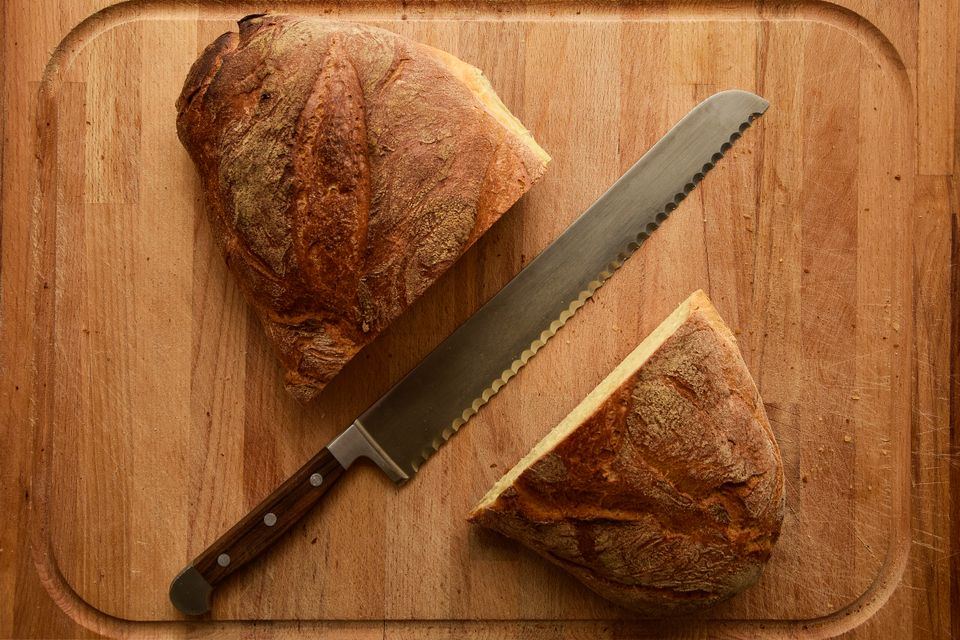
A bread knife is not compulsory in every kitchen. Someone mainly buying sliced bread may use one infrequently. If you regularly divide whole loaves, baguettes or rolls, however, a suitable serrated blade can have a clear purpose. Assess the purchase against the bread you buy and the working space available.
Let the loaf guide the length
Estimate the width of your usual loaves. The blade should allow enough movement for the intended cutting action without forcing you to work at its very end. A long baguette does not automatically require the longest blade because you will often slice across it. A broad round loaf creates different requirements. Make sure the selected length remains manageable on your board instead of constantly extending beyond its edge into the surrounding work area.
Check finger clearance and handle shape
A straight handle sits at different distances from the board depending on blade height. Hold the knife in your normal position and check that your fingers have sufficient room. A raised handle may help but still needs to suit your hand. Weight and balance should not make repeated movements unnecessarily tiring. A photograph of the blade alone shows these relationships poorly; dimensions or a permitted handling check in a shop are more informative.
Serrated edges need appropriate care
Read the sharpening guidance and check whether a proposed sharpening service handles that particular serration. An existing pull-through sharpener is not automatically suitable. Follow the knife’s cleaning requirements and plan for hand washing if specified. A matching cover or appropriate insert keeps the long blade organised in storage. Measure the complete knife, including the handle, before ordering a new drawer arrangement that may otherwise turn out too short.
Assess the additional task honestly
Consider whether your current knife is genuinely awkward with your usual bread or whether you simply want to complete a set. A specialist knife makes sense when it has a recurring job. For a rare large loaf, changing what you buy may also be an option. Compare a higher price against specific qualities such as suitable length, a comfortable handle and a clear care route. An included serving board does not improve the blade itself.
Before you buy
- Compare usual loaf width with your board dimensions.
- Check finger clearance in your actual grip.
- Read the care guidance for the particular serration.
- Measure total length for protected storage.
A separate bread knife earns its place through a recurring cutting task. Choose it around your bread, hand and board rather than the size of a collection.